
“Villa Corsini a Mezzomonte”, Florence
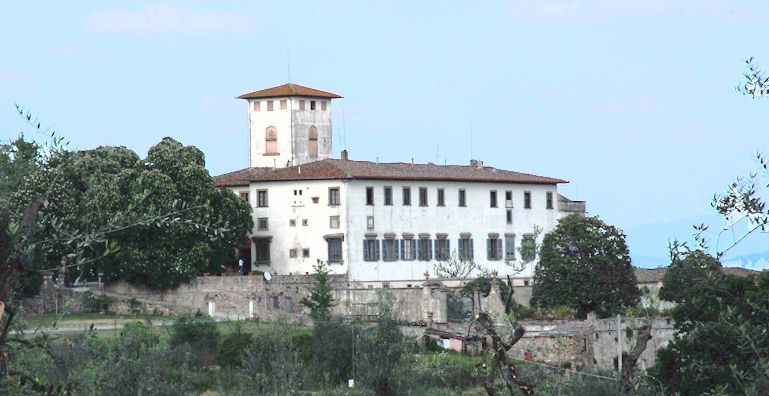
Villa Corsini a Mezzomonte
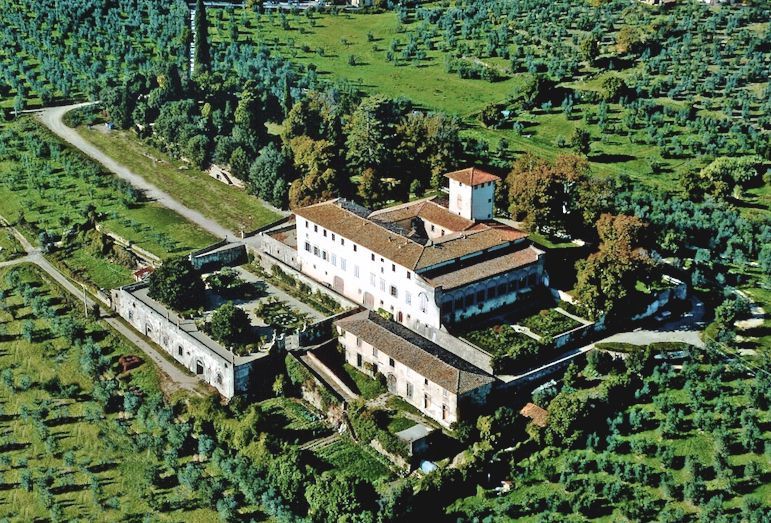
Villa Corsini a Mezzomonte from the air
Villa Corsini a Mezzomonte belonged to the Buondelmonti family in the 11 C. The building was initially a fortified farm. The current structure was created in the 14 C, built from "pietra forte" blocks, in the middle of the hill (hence the name, "mezzo-monte"). The Villa Corsini a Mezzomonte is now in typical Renaissance style, a square with a central courtyard. In the first years of the 14 C, the villa was bought by the Barduccio Ottavanti family. Lorenzo de Medici "the Magnificent" then bought it in 1480, but sold it two years later to Bernardo del Nero. Later on, the estate passed through the hands of the Ridollfi and Panciatichi families.
The Prince and future Cardinal Giovan Carlo de Medici (son of Cosimo II and of Maria Maddalena of Austria), brother to the future Grand Duke Ferdinando II, obtained Villa Corsini a Mezzomonte in 1629, when he was just 19 years old. Thanks to this young prince and his "chamber assistant", the Marquis Filippo Niccolini, today we have the frescoes, decorations and elegant italianate gardens of this stunning villa. Specialist artisans created the magnificent coffered ceilings which still exist in some halls. The construction work ended in 1632 and the villa was ready to be frescoed with a splendid set of paintings. Cecco Bravo, together with other minor artists, worked on the southern side of the villa on one the largest and most detailed cycles of paintings ever done in a Florentine villa. The frescoes represent scenes from "Orlando Furioso", "Gerusalemme Liberata" and other literary works, and are reminiscent of the Flemish style that was extremely popular throughout Europe at that time. Michele Colonna and Baccio del Bianco did the surrounding framework paintings of San Giovanni and Albani. In 1644, the Cardinal Giovan Carlo de Medici sold the villa to the Marchese Andrea del Senatore Neri Corsini.
(Note: do not confuse Villa Corsini a Mezzomonte with Villa Corsini at Castello ("I Rinieri"), another renaissance villa that houses the Florentine archaeological museum.)
Google
The Prince and future Cardinal Giovan Carlo de Medici (son of Cosimo II and of Maria Maddalena of Austria), brother to the future Grand Duke Ferdinando II, obtained Villa Corsini a Mezzomonte in 1629, when he was just 19 years old. Thanks to this young prince and his "chamber assistant", the Marquis Filippo Niccolini, today we have the frescoes, decorations and elegant italianate gardens of this stunning villa. Specialist artisans created the magnificent coffered ceilings which still exist in some halls. The construction work ended in 1632 and the villa was ready to be frescoed with a splendid set of paintings. Cecco Bravo, together with other minor artists, worked on the southern side of the villa on one the largest and most detailed cycles of paintings ever done in a Florentine villa. The frescoes represent scenes from "Orlando Furioso", "Gerusalemme Liberata" and other literary works, and are reminiscent of the Flemish style that was extremely popular throughout Europe at that time. Michele Colonna and Baccio del Bianco did the surrounding framework paintings of San Giovanni and Albani. In 1644, the Cardinal Giovan Carlo de Medici sold the villa to the Marchese Andrea del Senatore Neri Corsini.
(Note: do not confuse Villa Corsini a Mezzomonte with Villa Corsini at Castello ("I Rinieri"), another renaissance villa that houses the Florentine archaeological museum.)
 |
|
|
|
|
|
|
|
|
|
|
|
|
|
|
|
|
|
|
|
|
|
|